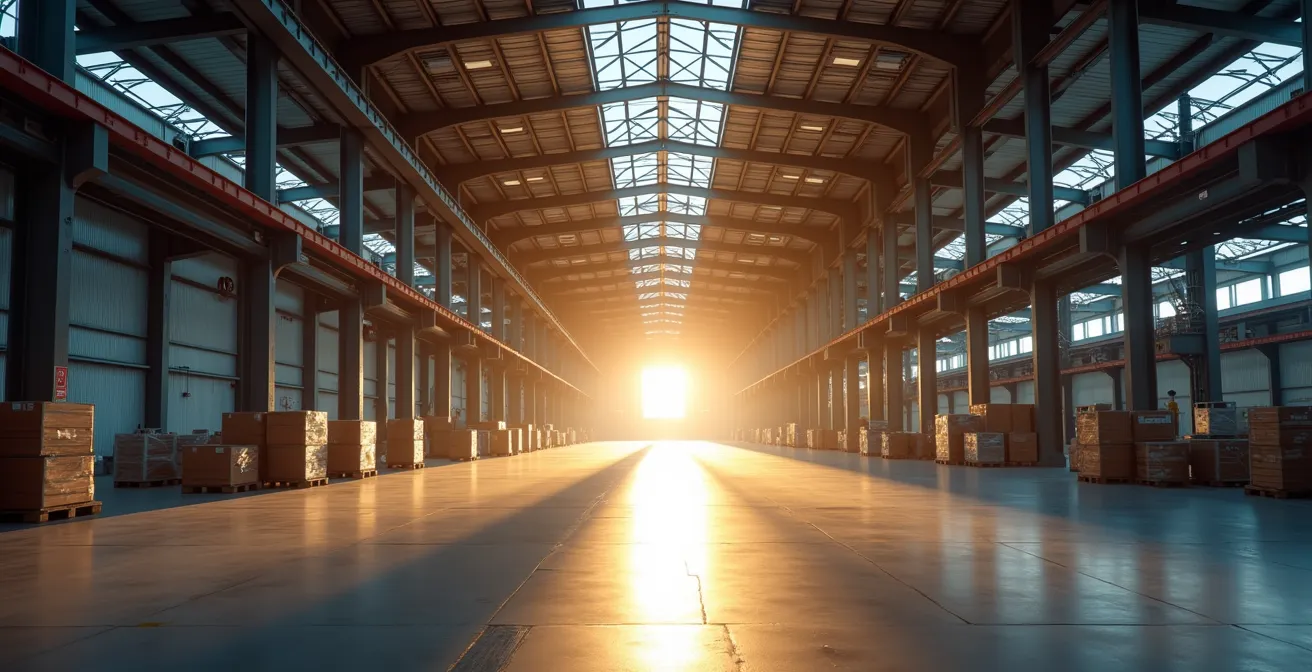
Successful industrial property acquisition is determined by a building’s operational capacity and future-readiness, not just its price or square footage.
- Metrics like clear height and dock door counts directly dictate a facility’s potential throughput and suitability for automation.
- Latent liabilities, such as environmental contamination or poor location economics, can neutralize any perceived upfront cost savings.
Recommendation: Shift your due diligence from a static financial assessment to a dynamic operational audit to underwrite the asset’s true long-term value in the supply chain.
For logistics directors and investors, acquiring industrial real estate often boils down to a familiar set of metrics: price per square foot, capitalization rate, and proximity to major highways. These are the standard data points, the comfortable territory of any pro forma. While essential, this narrow financial focus often overlooks a more critical reality. An attractively priced warehouse can quickly become a liability if its physical and operational characteristics create logistical friction, cap its throughput, or expose the owner to unforeseen liabilities.
The common wisdom to “check zoning laws” or “get an inspection” is table stakes. True competitive advantage in the warehousing sector comes from a deeper level of analysis. It requires moving beyond the building’s shell and underwriting its operational physics. It means understanding how factors like ceiling height, environmental history, and local infrastructure directly impact asset velocity and future-proofing. Many investors get trapped by a good deal on paper, only to discover the property is functionally obsolete for modern high-velocity supply chains.
This guide changes the lens of evaluation. We will deliberately move past the surface-level metrics to dissect the operational DNA of an industrial asset. We will explore why a building’s vertical volume can be more valuable than its horizontal footprint and how to de-risk an acquisition by identifying hidden environmental and locational traps. The goal is to equip you with a framework for identifying properties that don’t just serve as cost centers but can function as high-performance nodes in a resilient supply chain. This is about investing in operational capacity, not just real estate.
This article provides a structured approach to evaluating these critical, often-overlooked factors. Follow this guide to understand the key specifications and strategic considerations that separate a good investment from a capital trap.
Summary: A Practical Guide to Industrial Property Evaluation
- Why Ceiling Height and Dock Counts Are More Important Than Square Footage in Logistics?
- Phase 1 Environmental Assessment: How to Avoid Buying Contaminated Land?
- Brownfield vs Greenfield: Which Industrial Site Offers Faster Time-to-Operation?
- The Last-Mile Premium: Why Warehouses Near City Centers Command 30% Higher Rents?
- When to Buy Industrial Land: Anticipating Infrastructure Projects Before Prices Spike?
- The Location Risk: Why Buying Office Space in a Dying District Is a Capital Trap?
- How to Structure a Secured Line of Credit Specifically for Export Operations?
- Transforming Corporate Real Estate Holdings from Cost Centers to Revenue Generators?
Why Ceiling Height and Dock Counts Are More Important Than Square Footage in Logistics?
In industrial real estate, square footage is a misleading metric of capacity. The true measure of a modern logistics facility’s potential is its cubic volume and its ability to handle high-velocity inventory flow. This is where clear height—the usable height to the lowest overhead obstruction—and dock door counts become paramount. A building with a 24-foot clear height is functionally obsolete for modern distribution, which increasingly relies on vertical racking and automation. As a testament to this shift, average warehouse clear heights have climbed from 28 feet to 32.3 feet in the last decade alone, with new builds often targeting 36 to 40 feet to accommodate robotics.
This vertical space is critical for implementing technologies like Automated Storage and Retrieval Systems (AS/RS). These systems use the full volume of a warehouse, drastically increasing storage density. For example, a well-designed AS/RS can increase usable storage space by as much as 40% within the same footprint by minimizing aisle widths and maximizing vertical reach. This directly translates to lower storage cost per pallet and higher operational throughput.
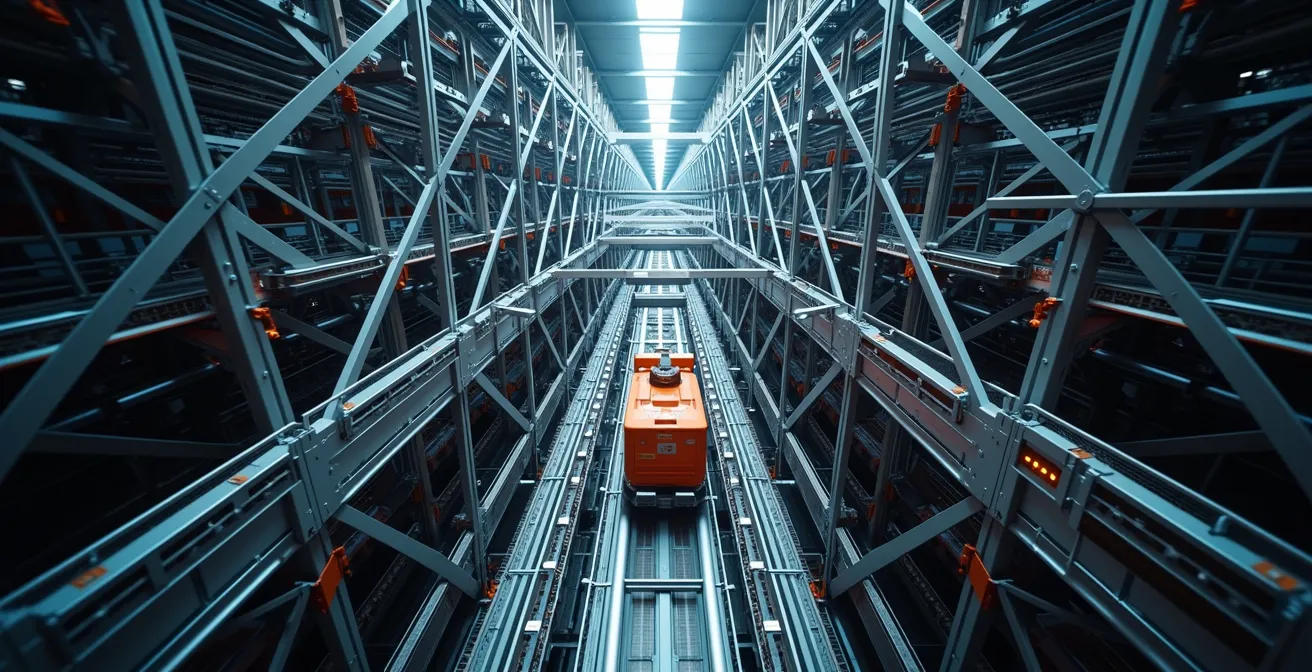
Similarly, the number and type of dock doors dictate a facility’s “asset velocity”—how quickly goods can be moved in and out. An inadequate number of docks creates bottlenecks, forcing trucks to wait and adding costly delays to the supply chain. A proper analysis evaluates the dock-to-square-foot ratio, the presence of levelers, and whether there is sufficient truck court depth for maneuvering modern 53-foot trailers. Prioritizing these operational specs over simple square footage ensures the property can support, not hinder, a high-velocity logistics operation.
Case Study: AS/RS and Space Optimization
A key benefit of focusing on clear height is the ability to deploy automation. According to industry data, AS/RS systems can increase usable space by as much as 40%. By utilizing vertical space and reducing the need for wide, human-accessible aisles, companies can fit significantly more inventory into the same building footprint, directly boosting the asset’s ROI by increasing its storage capacity without physical expansion.
Phase 1 Environmental Assessment: How to Avoid Buying Contaminated Land?
A Phase 1 Environmental Site Assessment (ESA) is a critical due diligence step designed to identify potential or existing environmental contamination liabilities. This investigation, which typically costs between $2,000 to $4,500 for most properties, is not a superfluous expense but a fundamental de-risking tool. Its purpose is to research the historical use of the property and surrounding land to determine if activities like manufacturing, chemical storage, or fuel operations may have left behind hazardous substances in the soil or groundwater. Ignoring this step can expose a new owner to cleanup costs that can dwarf the original purchase price.
The legal stakes are exceptionally high. Under federal law, a landowner can be held responsible for remediation, even if they were not the source of the contamination. Conducting a proper Phase 1 ESA before acquisition is the key to qualifying for the “Innocent Landowner Defense.”
Sometimes, the Environmental Protection Agency (EPA) holds property owners responsible for contamination under the Comprehensive Environmental Response, Compensation, and Liability Act (CERCLA), even if the contamination predated the individual’s ownership of the property. If contamination is discovered later, property owners can avoid liability by claiming innocence if a proper Phase 1 ESA was conducted before acquisition.
– Alpha Environmental, Phase 1 ESA Expectations Guide
The process involves a thorough review of historical records, aerial photographs, and government databases, as well as a site inspection and interviews with past owners or operators. If the Phase 1 ESA reveals “Recognized Environmental Conditions” (RECs), a more invasive Phase 2 investigation, involving soil and water sampling, may be required. While a clean Phase 1 report provides significant peace of mind, the discovery of a REC doesn’t necessarily kill a deal. It provides crucial information for negotiating remediation responsibilities or a price reduction, transforming an unknown liability into a manageable, quantifiable risk.
Brownfield vs Greenfield: Which Industrial Site Offers Faster Time-to-Operation?
When considering a new industrial development, investors face a fundamental choice: a greenfield site (undeveloped land) or a brownfield site (previously developed land that may have contamination issues). While greenfields offer a blank slate for custom design, brownfields often provide a significantly faster path to operational readiness. This is because brownfield sites typically have critical infrastructure—such as roads, utilities, and rail access—already in place. This existing framework can dramatically shorten project timelines and reduce initial capital outlay.
The primary trade-off is development time versus initial complexity. A greenfield project involves extensive site preparation, entitlement processes, and utility installation, which can be time-consuming and unpredictable. In contrast, a brownfield redevelopment leverages existing assets, though it may require environmental remediation. The timeline difference, however, is often stark.
The following table, based on industry analysis, highlights the critical differences in project timelines and strategic advantages between the two site types.
| Aspect | Greenfield | Brownfield |
|---|---|---|
| Development Timeline | 18 to 36 months | 6 to 12 months |
| Speed to Market | Longer development cycles; not ideal if you must be operational quickly | Faster ramp-up; suited for companies reacting to immediate market growth |
| Key Advantage | Complete design freedom for a purpose-built facility | Lower initial capital costs; presence of infrastructure allows faster project timelines |
Case Study: IKEA’s Brownfield Transformation in Slovakia
IKEA Components successfully converted an existing manual facility into a highly automated warehouse without halting operations. The project leveraged the existing building structure and racking, demonstrating the power of brownfield redevelopment. Managing Director Frantisek Stora noted that while the project was more complex than a greenfield build, the ability to upgrade an operational facility was a complete success, showcasing the strategic advantage of adapting existing infrastructure for modern logistics needs.
The Last-Mile Premium: Why Warehouses Near City Centers Command 30% Higher Rents?
The term “last-mile” refers to the final step of the delivery process from a distribution center to the end customer. In the age of e-commerce, the efficiency of this final leg is paramount, and it has created a distinct real estate sub-market: urban infill logistics. Warehouses located near major population centers command a significant rent premium for a simple reason: they reduce transportation costs and enable faster delivery times, which are now a primary driver of consumer choice. In fact, proximity to consumers is so valuable that urban facilities’ rents have climbed more than 30% over the past five years.
This premium is fueled by powerful market forces. With U.S. e-commerce projected to hit nearly $1.3 trillion by 2025, consumer expectations have fundamentally shifted. In 2024, approximately 70% of U.S. shoppers anticipated same-day or next-day delivery, a massive jump from just 40% in 2019. Meeting this demand is impossible from remote, large-scale distribution centers. Companies must position inventory closer to the end customer, making smaller, well-located urban warehouses mission-critical assets. This demand has pushed average rents for these last-mile facilities to around $13.50 per square foot, substantially higher than their suburban counterparts.
For an investor, this means location analysis must be re-evaluated. It’s no longer just about access to highways but about proximity to residential density. Evaluating a potential last-mile facility requires analyzing demographic data, local traffic patterns, and the competitive landscape for delivery services. While the acquisition cost and rental rates are higher, these properties offer stronger rent growth potential and lower vacancy risk due to the relentless demand for speed in the e-commerce supply chain. The “last-mile premium” is not a temporary trend but a structural shift in how industrial real estate is valued.
When to Buy Industrial Land: Anticipating Infrastructure Projects Before Prices Spike?
The most sophisticated industrial investors don’t just react to current market conditions; they anticipate future value creation. A primary catalyst for appreciation in industrial land is the development of new public infrastructure. Projects such as new highway interchanges, port expansions, or freight rail lines can fundamentally reshape logistics networks, turning previously secondary locations into prime distribution hubs. Acquiring land in the path of this progress, before the projects are widely publicized and priced into the market, is a key strategy for generating outsized returns.
This requires a proactive approach to due diligence. Instead of only analyzing current comparables, investors should be monitoring municipal and regional transportation plans, attending public planning meetings, and studying long-term capital improvement budgets. Identifying areas designated for future infrastructure investment allows an investor to acquire assets based on their future potential, not their current utility. As noted by industry analysts, the market is already shifting away from passive assets.
Industrial sales rose 25% year over year, with investors focusing on operational upside, shorter leases and embedded rent growth rather than just square footage… small-bay industrial spaces with sub-4% vacancy and 50% leasing growth attracted private capital due to limited new supply and flexible layouts.
Furthermore, the quality of the asset itself is becoming inseparable from its location. The era of “good enough” industrial space is over. Modern tenants require “infrastructure-ready” properties that can support advanced automation and resilient operations. This means facilities with high clear heights (33 feet or more), robust power and HVAC systems, and fiber optic connectivity. Assets with these features are positioned to command premium rents as tenants increasingly seek efficiency gains through technology. Buying land or buildings with this future in mind is a form of infrastructure investment in itself, positioning the asset to capture the demand of tomorrow’s supply chain.
The Location Risk: Why Buying Office Space in a Dying District Is a Capital Trap?
In the world of commercial real estate, a common cautionary tale is that of the investor who buys Class B office space in a district with a declining economic base. Even if purchased at a steep discount, the asset becomes a capital trap as tenancy erodes, rents fall, and the property becomes illiquid. This same principle of location risk applies with equal force to the industrial sector. An industrial property is not an island; its value is inextricably linked to the economic health of its surrounding ecosystem. A low purchase price cannot compensate for a failing location.
The warning signs of a “dying district” for industrial property are often subtle but potent. They include the departure of a major anchor employer, which can have a ripple effect on the local supply chain and labor pool. Other indicators are deferred municipal maintenance, evidenced by deteriorating roads and an unreliable power grid, or a shrinking skilled labor force. As the national industrial vacancy reached a decade high of 7.5% in mid-2025, competition for tenants has intensified, making location quality more critical than ever.
For investors, this means conducting a macro-level analysis that goes far beyond the four walls of the target property. It’s crucial to assess the long-term viability of the local market. Is the area attracting new businesses or losing them? Is residential encroachment creating rezoning pressures that could render industrial use non-conforming in the future? A thorough risk assessment can prevent the acquisition of a seemingly cheap asset that is, in reality, on a path to obsolescence. Before any acquisition, a rigorous audit of these external factors is essential.
Action Plan: Auditing Your Target Location’s Risk Profile
- Anchor Employer Health: Identify the top 3-5 major employers in the submarket. Are they growing, stable, or downsizing? The loss of a key anchor can signal systemic economic decline.
- Infrastructure Vitality: Drive the area and physically inspect the condition of roads, bridges, and access points. Check local news and municipal reports for any mention of deferred maintenance on the power grid or water systems.
- Labor Pool Dynamics: Analyze local census and labor department data. Is the skilled labor pool required for modern logistics (e.g., technicians, drivers) growing or shrinking? A declining labor pool is a major red flag.
- Zoning and Encroachment: Review the municipality’s long-term land use plan. Is there significant residential development moving closer to the industrial zone? This can lead to future operating restrictions and rezoning pressure.
- Market Saturation: Investigate the development pipeline. Is an excess of new warehouse space about to flood the market from speculative builds or big-box retailer bankruptcies? This can severely depress rental rates.
How to Structure a Secured Line of Credit Specifically for Export Operations?
While traditional industrial property financing focuses squarely on the acquisition cost, a more strategic approach is required for assets intended to play a role in complex supply chains, such as those involving export operations. The financing should not be viewed as a static, one-time transaction but as a flexible tool for enabling the property’s full operational potential. This means structuring a loan that anticipates future needs, particularly capital expenditures (CapEx) for upgrades and automation. This is especially relevant for exporters who may need to adapt facilities to meet specific international shipping standards or install specialized handling equipment.
Forward-thinking investors are moving away from rigid mortgages and toward “CapEx-ready” financing arrangements. These structures include pre-approved drawdowns for future upgrades, treating the loan as a revolving facility for supply chain evolution. This approach provides the agility to respond to new opportunities or technological shifts without having to go through a full refinancing process. For an exporter, this could mean quickly financing the installation of a new cold storage unit or a container handling system to secure a new international contract.
The table below contrasts the traditional approach to property financing with this more strategic, CapEx-focused model, which is better suited for dynamic operations like exporting.
| Aspect | Traditional Mortgage | Strategic CapEx-Ready Loan |
|---|---|---|
| Primary Focus | Property acquisition only | Acquisition + future upgrades |
| Flexibility | Fixed terms, limited modifications | Pre-approved expansion drawdowns |
| Automation Readiness | Not considered | Built into financing structure |
| ROI Potential | Limited to property appreciation | Enhanced by operational improvements |
By building this flexibility into the initial loan structure, an investor or owner-operator ensures that the real estate asset and its financing are aligned with the operational strategy. This transforms the property from a simple line item on the balance sheet into a dynamic platform for growth, capable of adapting to the evolving demands of global trade and logistics.
Key Takeaways
- Volume Over Area: A modern warehouse’s value lies in its cubic capacity and throughput potential, dictated by clear height and dock doors, not just its floor space.
- De-Risking is Non-Negotiable: Latent liabilities from environmental contamination (Phase 1 ESA) and declining local economics are quantifiable risks that must be audited before acquisition.
- Location is About Logistics: Proximity to consumers (last-mile) and future infrastructure projects are more powerful value drivers than a simple address or highway access.
Transforming Corporate Real Estate Holdings from Cost Centers to Revenue Generators?
An industrial property should be more than just a cost center on a corporate balance sheet. With a strategic mindset, these assets can be transformed into active revenue generators. The key is to look beyond the primary function of the building—be it manufacturing or storage—and identify underutilized components of the property that can be monetized. This approach, often called “asset optimization,” can create new, high-margin income streams that enhance the property’s overall return on investment.
For example, a large, flat roof on a warehouse in a sunny region is an ideal candidate for a solar farm lease. The rooftop space, otherwise unused, can generate steady income from a utility company or a third-party solar developer. Similarly, excess land, particularly paved areas intended for trailer parking, can be leased to other local businesses or trucking companies facing a shortage of secure parking. These opportunities leverage existing assets without interfering with the core operations of the facility.
The potential for revenue generation extends to services as well. A company with advanced logistics capabilities can offer third-party logistics (3PL) services during its off-peak hours, utilizing its existing workforce and equipment to serve other businesses. Other modern strategies include:
- Offering on-site EV fleet charging services to nearby companies.
- Leasing unused wall or roof space for 5G/telecom antenna installations.
- Licensing access to the facility’s “digital twin” for simulation and training purposes.
A facility with a raised clear height is not only more efficient for its primary user but also more attractive to a wider range of high-value tenants, from e-commerce to specialized manufacturing, thereby commanding higher rents and enhancing its value as a monetizable asset.
By applying these advanced evaluation metrics, you move from being a passive real estate buyer to a strategic investor in the supply chain. To put these concepts into practice, the next logical step is to conduct a detailed operational needs analysis and a market audit for your specific target area.